Why we did not remove the printing step
A Cyprus audit practice prints every document and writes a reference number on it by hand. It looks like the first thing to automate away. It is the one thing that cannot be touched.

Omri Dan · Nomadan founder
Every document that arrives at GMAP Associates gets printed, marked with a handwritten reference number, and filed in a box file. Only then does anyone key it into the accounting software.
They are Certified Public Accountants in Larnaca, holding a fiduciary licence, which means they carry the corporate record as well as the books for a few hundred Cypriot businesses. Their bookkeeping runs nine steps from a client uploading a document to a number reaching the government portal.
Read those nine steps and one of them jumps out as obviously wasteful. It is the wrong one.
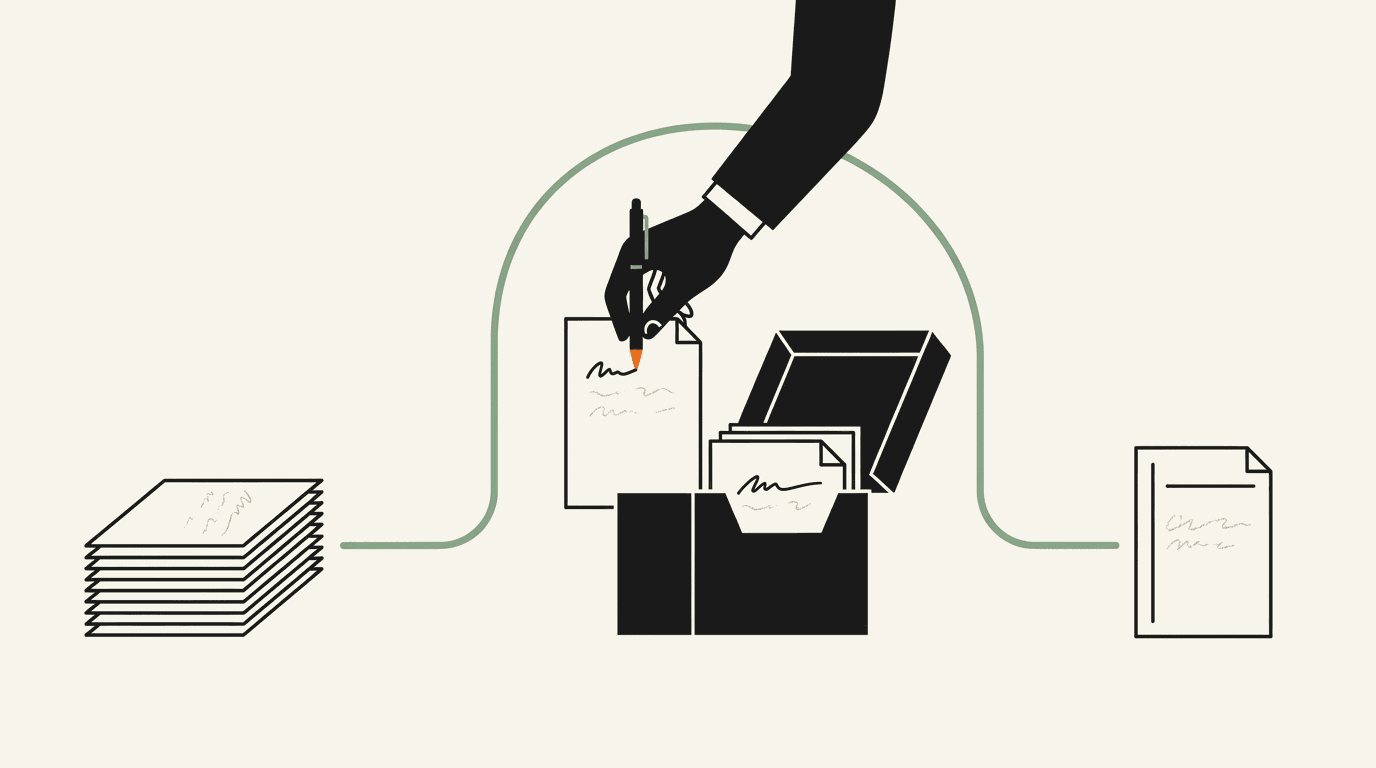
The step that looks like waste
I asked their head of bookkeeping why they print everything. The answer took about four seconds:
"Just to have the proof document with our reference and the box files."
Those paper files are what the regulator inspects. And they are in better condition than the electronic ones, because the electronic files drifted across years of handovers between people while the box files stayed exactly as filed.
So the printing is not a habit left over from before the shared drive. It is the control. It is the thing that makes everything else defensible when someone comes to check.
Automating around that control is the job. Removing it was never available, and a consultant who arrived with a plan to digitise the paper would have spent the engagement being listened to politely and ignored completely.
The test. Point at the most obviously wasteful step in a process and ask the person who does it why it is there. If they answer immediately and the answer involves someone outside the business, it is a control and it stays. If they say it is just how things have always been done and nobody can name who needs it, it is a habit, and it is fair game.
What the first session is for
Session one was two hours, and I built nothing during it. It was mapping. Nine steps written down in order, four named exceptions that break a naive pipeline, and a list of the places where the work hurts.
The exceptions are where the value hides. E-commerce clients upload consolidated spreadsheets that post as a single summary entry rather than line by line. Some hard copies never reach the server at all. Handwritten receipts get flagged, never guessed at. Everything is in Greek, which turns out not to matter.
None of that is in a process document, because there is no process document. It lives in the heads of the people doing the work, and the only way to get it out is to sit with them and ask.
The test. Ask a vendor what they will do in the first two hours. If the answer is that they will watch your team work and write down what they find, they intend to build for your business. If the answer is a demo, they intend to build the thing they already built.
Two altitudes, so knowledge can move and client data cannot
The system learns. Every correction someone makes is knowledge that should not have to be given twice. But this practice holds records for hundreds of businesses and their beneficial owners, and the thing doing the learning syncs between machines.
So every learned fact splits in two, and choosing the split is the system's job rather than the user's.
Shared
syncs between machines
The general rule. Payment-processor fees post to a particular nominal account. True at any firm, names nobody.
Private
never leaves the building
The client-specific detail. That this particular business labels those charges a particular way on their statement.
Would this sentence still be true and useful at a different firm with different clients?
If it names a client, a registration number, a VAT number, a bank account or a person, it is private. That one rule is what lets something the bookkeeper works out on Tuesday reach a colleague's machine the following week, without a single client's data moving anywhere.
What it changed
Andreas, who runs the practice, puts the outcome in his own words on our homepage:
"Most of our week was admin: chasing documents, sorting invoices, the same filings. Omri built the systems that take that off, and we handle more clients without growing the staff."
Note what is not in that sentence. Nobody left. The paper file still gets printed and marked by hand, the regulator still finds it in better condition than the electronic copy, and a qualified person still signs everything that carries the firm's name.
Most automation projects break somewhere in that gap. Not because the technology was not ready, but because nobody spent two hours finding out which of the wasteful-looking steps was holding the whole building up.