The drafting moved inside the system
A legal specialist was using Claude as a better search engine. Three or four sessions later the drafting had moved. Here is what changed, and what deliberately did not.

Omri Dan · Nomadan founder
Most people who tell me they already use AI at work mean one specific thing. They open a chat window, ask it something, read the answer, and go back to the document they were writing.
That is a better search engine. Useful, and not what these tools do.
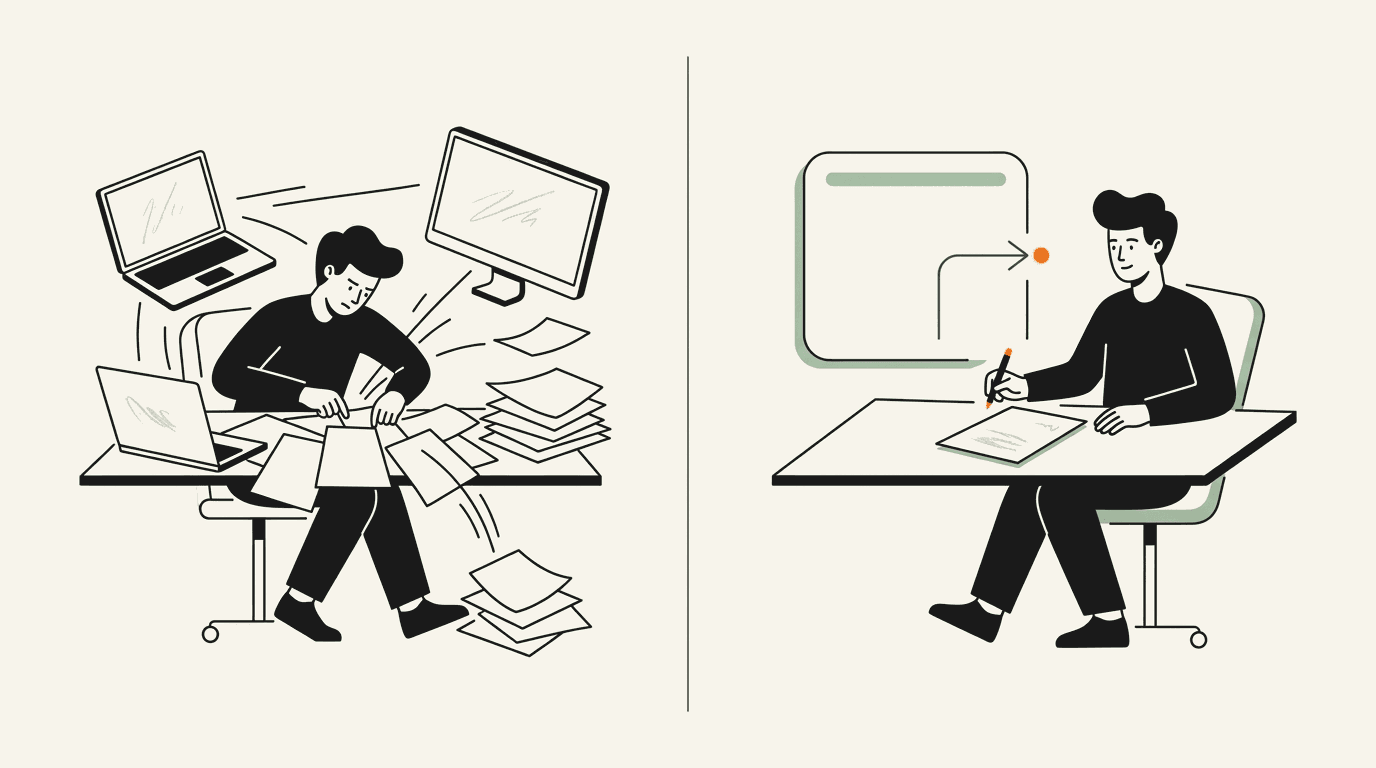
What follows is a build in the legal and compliance function of a cybersecurity business. The specialist who does that job is not named, and the story is about the work rather than the person.
What the work looked like before
Documents assembled by hand. Google Docs and Excel open side by side. Precedent found by remembering which earlier matter it was in, then opening that file and copying across. Templates existed in the sense that old documents existed.
And the chat window open in a third tab, answering questions.
The gap between those two things is the whole story. A system that could produce the document was already sitting there, and it was being used to look things up while a person produced the document anyway.
The test. Ask whoever is selling you AI to name the artifact it produces. If they name one, a drafted letter, a filled ledger row, a finished summary, then you can check next week whether it arrived. If the answer is that it helps your team work faster, you are being sold a search engine with a subscription attached.
Three or four sessions, and what happens in them
Three or four. It surprises people, so it is worth saying what the sessions were.
The first is mapping, and it is mostly the specialist talking. Which documents get produced, in what order, pulling which facts from where, and which rules never bend. Not the process as anyone would describe it in a meeting. The one that actually ran last Tuesday, including the parts that are embarrassing.
Then the build happens off the call. What comes out is not a prompt. It is a set of files describing how legal work is done in that business: the document types, the jurisdictions, the house formatting, the phrasing that gets used and the phrasing that never does. Call it the memory. It is closer to a written-down version of the job than to anything people picture when they hear AI.
Then a session to install it and work through real matters together, correcting it out loud. When it gets something wrong you fix the output, then you say why, and it writes the rule down.
By the fourth session there was a dashboard built on top of it that nobody had asked for.
The surface matters here, and it is the part people get wrong. This was not a developer tool. It runs in Claude's desktop workspace, which sits between the chat window and the full engineering environment, and that is why a non-technical specialist could take it over instead of depending on me to operate it.
The demo that made it land
The moment it became obvious was a GDPR letter produced from a single line of instruction. One sentence in, a complete correctly formatted letter out, with the details already known rather than retyped.
That is the whole difference in one artifact. Not a smarter answer to a question. The thing that would otherwise have taken the afternoon.
Why the review step stayed
Every word still gets read before it goes anywhere.
That is not a caveat bolted onto the end, it is the design. Legal and compliance work is regulated, client-facing, and expensive to get wrong in ways that are hard to reverse. So the system drafts and assembles, and a qualified person reviews and signs. Sending is a stop. Filing is a stop. Nothing leaves without a person deciding it should.
The productivity framing gets this backwards, and the industry keeps selling the backwards version. The review step is not the tax you pay for using the tool. The review step is the part that was always the actual job. What the system took over was the mechanical assembly around it: finding the precedent, laying out the format, retyping details that were already known somewhere else.
The test. Take the workflow you are thinking of handing over and draw a line through it, judgement on one side, assembly on the other. If the line is obvious and you can say which side every step falls on, the workflow is ready. If you cannot find the line, it is not, and automating it will bury the judgement instead of supporting it.
The bottleneck nobody names
What changed it was not a better model. It was writing down how the work is done, which nobody had ever done, and putting that somewhere the system reads every time.
Most specialists are one mapping conversation away from this. The knowledge is already in their head in complete detail, and it has never once left it.
The job did not stop being legal work. It stopped being typing.